
TL;DR
A hiring scoring rubric is a short, shared scorecard you write before you open applications. Score the same few job-related categories for every person—role match, impact, and skills work well—keep knockouts pass/fail, then rank. AI can apply those custom rules at volume. You still set the weights and make the hire.
Definition
A hiring scoring rubric is the written scale your team uses to mark the same job-related categories on every applicant (for example role match, proof of impact, and skills), so how to rank job candidates is a comparison against the role—not a vibe that changes by file forty.
Gut ranking feels fast until file twenty. Then the bar slides. The person who applied Monday is judged on “energy.” The person who applied Friday is judged on a tool they never listed. A candidate scorecard stops that. You decide the exam once. You mark everyone on it.
Evidence
Google’s re:Work guide (updated March 2026) treats a shared rubric as core to structured hiring: the same questions, the same scale, and notes so later readers can see why a score was given. Google’s hiring team reports that using prepared questions and rubrics saves about 40 minutes per interview, and rejected candidates who went through a structured interview were 35% happier than those who did not.
How Do You Create a Hiring Scorecard?
How do you create a hiring scorecard?
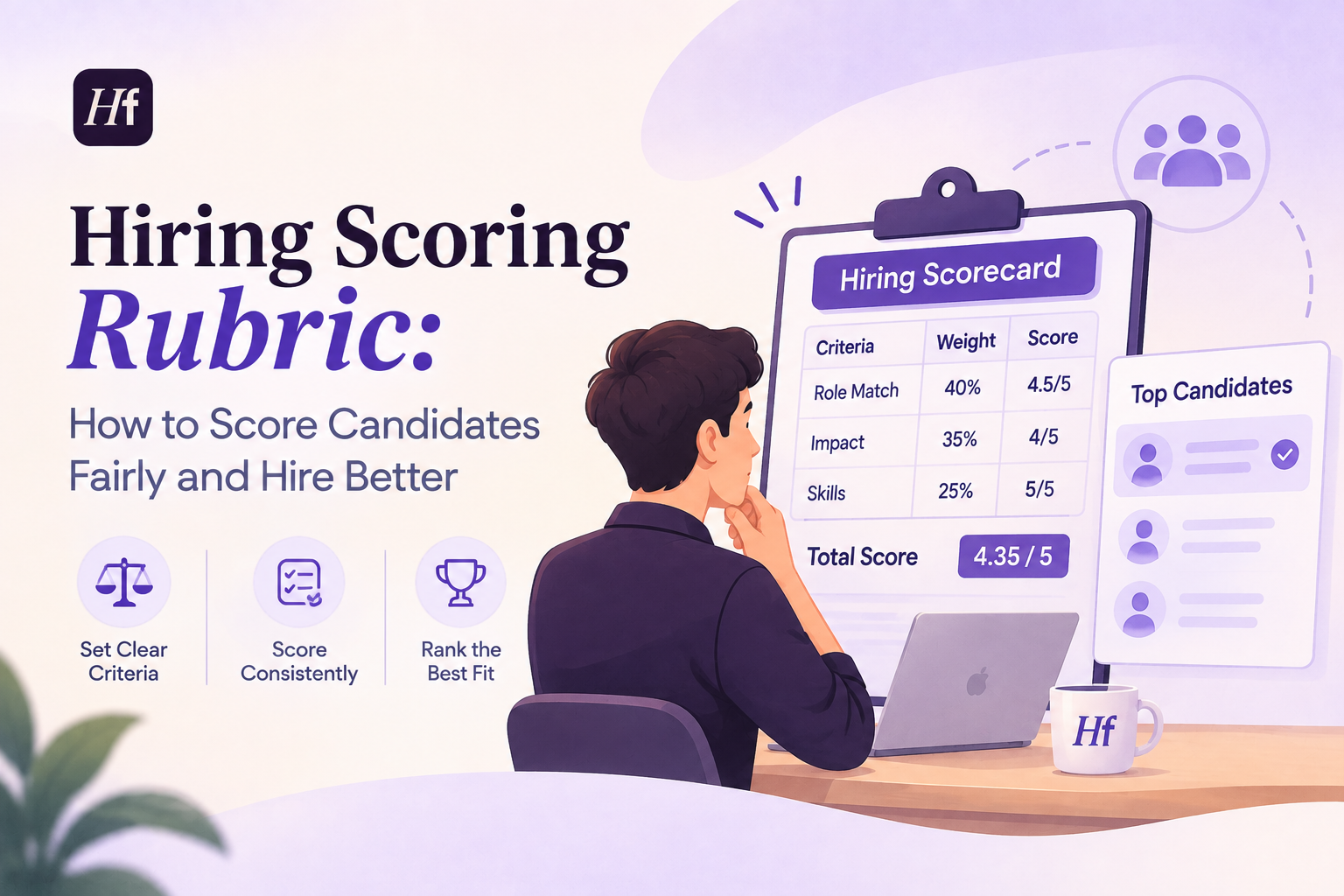
Write the scorecard before volume hits. Pick three to five job-related categories, say what a weak vs strong mark looks like, separate true knockouts from scores, and use weighted hiring criteria so the job’s real priority is not buried. Then score independently. Talk as a group last.
You do not need Google’s four-level interview kit on day one. You need a candidate scorecard a founder will actually fill in. On the card itself, write:
- The category name
- One line for a low mark
- One line for a high mark
- The weight (must add to 100 across categories)
- List the work of the next 90 days—not a fantasy senior hire.
- Turn that work into three scored categories: role match, impact, skills (add one more only if the job truly needs it).
- Write one line for a low / mid / high mark on each category.
- Put knockouts aside as pass/fail (licence, location, work authorisation).
- Set weights that add to 100 so weighted hiring criteria match the job.
- Score every applicant on that card—or let AI apply the same custom rules, then you review the shortlist.
- Rank by total, then interview with the same questions.
Google re:Work grades answers as poor, borderline, solid, or outstanding, with examples of each. You can use 1–5, or a 100-point total. The scale matters less than using it twice.
For a first-pass that uses the same idea on CVs, read Hiring Forms’ How to Screen Resumes Faster Without Losing Quality.
What Criteria Should You Use to Score Candidates?
What criteria should you use to score candidates?
Use criteria the job actually needs. For most lean-team roles, three buckets are enough: role match (is this the work?), impact (have they shipped something like it?), and skills (tools and craft you will use weekly). Keep “culture” and “potential” out of the numeric gate at CV stage. Knockouts stay binary.
That trio is the spine of a practical hiring scoring rubric. It maps cleanly onto custom screening categories: you name them, you weight them, you score them.
| Category | What you are marking | Weak signal | Strong signal |
|---|---|---|---|
| Role match | This job, not a nearby title | Same industry, different work | Same problems, similar constraints |
| Impact | Proof they moved a number or shipped | Duties listed, no outcome | Before/after, owners, results |
| Skills | Tools and methods you will use | Buzzwords, no depth | Used in production, can teach a peer |
| Knockouts (not a score) | True disqualifiers | ”We usually like five years” | Licence, location, legal constraint |
Definition
Weighted hiring criteria are category scores that are not treated as equal: you decide up front that role match might count for more than a nice-to-have tool, then you add those weighted marks so ranking reflects the job you posted.
A starting split many product and ops roles can try—then you should change it:
- Role match: 40
- Impact: 35
- Skills: 25
Sales might flip impact higher. A regulated role might put a licence in knockouts, not in skills. There is no universal formula. There is a written one.
Myth
“If we score everything, including culture and ‘hunger,’ the ranking will be fairer.”
Reality
Extra categories become a dumping ground for likeness. Google’s interviewer guidance is blunt: do not get distracted by personality and “fit,” or grade things unrelated to the job. Mark the work. Talk about working style in the interview, not as a CV score.
Where U.S. rules apply, tests and other selection procedures must be job-related if they disproportionately exclude a protected group (EEOC). A hiring scoring rubric is a selection procedure. Prestige-school points are not “skills.” The same idea—same criteria, same order—is the bias reducer in Hiring Forms’ The Hidden Bias in Resume Screening (And How to Reduce It).
How to Rank Job Candidates Without Changing the Exam
How do you rank job candidates with a weighted scorecard?
Score first, rank second. Apply knockouts, then add the weighted category marks, then sort. Do not re-weight after you like someone. If two people tie, use a written tie-break (stronger impact evidence, not “I liked them more”). AI ranking should use your categories, not a mystery model of “good.”
Did You Know?
CIPD cites evidence that a scoring rubric—how to judge each response—increased the likelihood that Black women would be selected for a role by 21%. Structure changes who gets through.
Source: CIPD — Inclusive recruitment
Hiring Forms is built for that first pass: custom categories, a score out of 100, knockout-rule checks, and a ranked shortlist. That is your hiring scoring rubric applied at volume. AI screening is decision-support. You still set the rules and make the hire. Start with one role—signup includes 25 free AI screening credits.
| Approach | How you rank | Typical failure |
|---|---|---|
| Gut / arrival order | Whoever feels strong today | File forty is judged tired |
| Equal ticks on ten items | Sum of mixed signals | Nice-to-haves beat the job |
| Weighted card (role match, impact, skills) | Written priorities | Weak if weights ignore the real work |
| AI score on your categories | Same card, faster | Weak if you never wrote the card |
Expert Insight
“Structured interviews are one of the best tools we have to identify the strongest job candidates.” — Dr. Melissa Harrell, former hiring effectiveness expert, Google People Analytics, quoted in Google re:Work
A score without a pipeline still stalls. For more on that delay, read Hiring Forms’ Why Most Startups Take Too Long to Hire (And How to Fix It).
Lean-Team Hiring Context: Three Numbers Beat a Debate
A founder does not need a 12-row competency matrix. Three categories and a knockout list fit on one page. Fill it after each screen. Independent notes first. Then argue.
India-based teams should keep local proxies out of the numeric score:
- Campus brand as a skills mark
- CTC “fit” as impact
- Notice period as character
- English flourish as role match
Put real constraints on the form. Score the work.
First-Hand Experience
Lean teams rarely lack opinions. They lack a shared card. The usual pattern is a Drive folder, then a call where the loudest voice wins. Teams that score role match, impact, and skills the same way for every applicant—and keep knockouts binary—still disagree in interviews. They just stop changing the test halfway through the pile.
Evidence
CIPD’s inclusive-recruitment guidance is that a rubric which sets out scoring criteria and how to judge each response is associated with a 21% higher chance that Black women would be selected. A candidate scorecard is not only a speed tool. It is a fairness tool when the categories are job-related.
Source: CIPD — Inclusive recruitment: Guide for people professionals
Comparable applications make the card easier to fill. For more on intake that is not a survey row, read Hiring Forms’ Google Forms vs. Hiring Forms: Why Spreadsheets Break Down When You’re Hiring.
Can a small team rank job candidates without an HR department?
Yes—if the hiring scoring rubric is written before the pile, and everyone uses it.
A usable scorecard can:
- ✓ Score role match, impact, and skills the same way for every person
- ✓ Use weighted hiring criteria that match the real job
- ✓ Keep knockouts pass/fail
- ✓ Let AI apply those custom rules as decision-support
It cannot replace:
- ✗ A clear brief for the seat
- ✗ Human judgement on people you might hire
- ✗ Weights that are actually about the work