
TL;DR
Bias in resume screening is not a rumour. Identical CVs get different callbacks when names and other cues change. You reduce it with fair hiring practices: the same scoring criteria for every applicant, job-related knockouts, structured applications, and humans who still own the hire. Blind hiring helps in some cases. It is not a complete fix.
Definition
Bias in resume screening is the systematic advantage or penalty some applicants receive at the first-pass stage because of cues that are not the work itself — name, school, dates, postcode, photo, or “culture vibe” — instead of comparable evidence scored against a written rubric.
Most lean teams don’t sit down to discriminate. They open PDFs in a hurry. That’s bias in resume screening as it actually happens: unconscious bias hiring, not a policy. Awareness posters don’t shortlist people. Consistent scoring criteria do.
A fast, unstructured pass typically notices:
- Name, photo, and “people like us”
- School brand instead of job proof
- Exact dates, gaps, and age cues
Evidence
A 2022 Quarterly Journal of Economics correspondence study sent more than 83,000 fictitious applications to jobs at 108 large U.S. employers. Distinctively Black names reduced the chance of employer contact by 2.1 percentage points relative to distinctively white names on otherwise comparable applications.
Source: Kline, Rose, and Walters — Systemic Discrimination Among Large U.S. Employers
Is Resume Screening Biased?
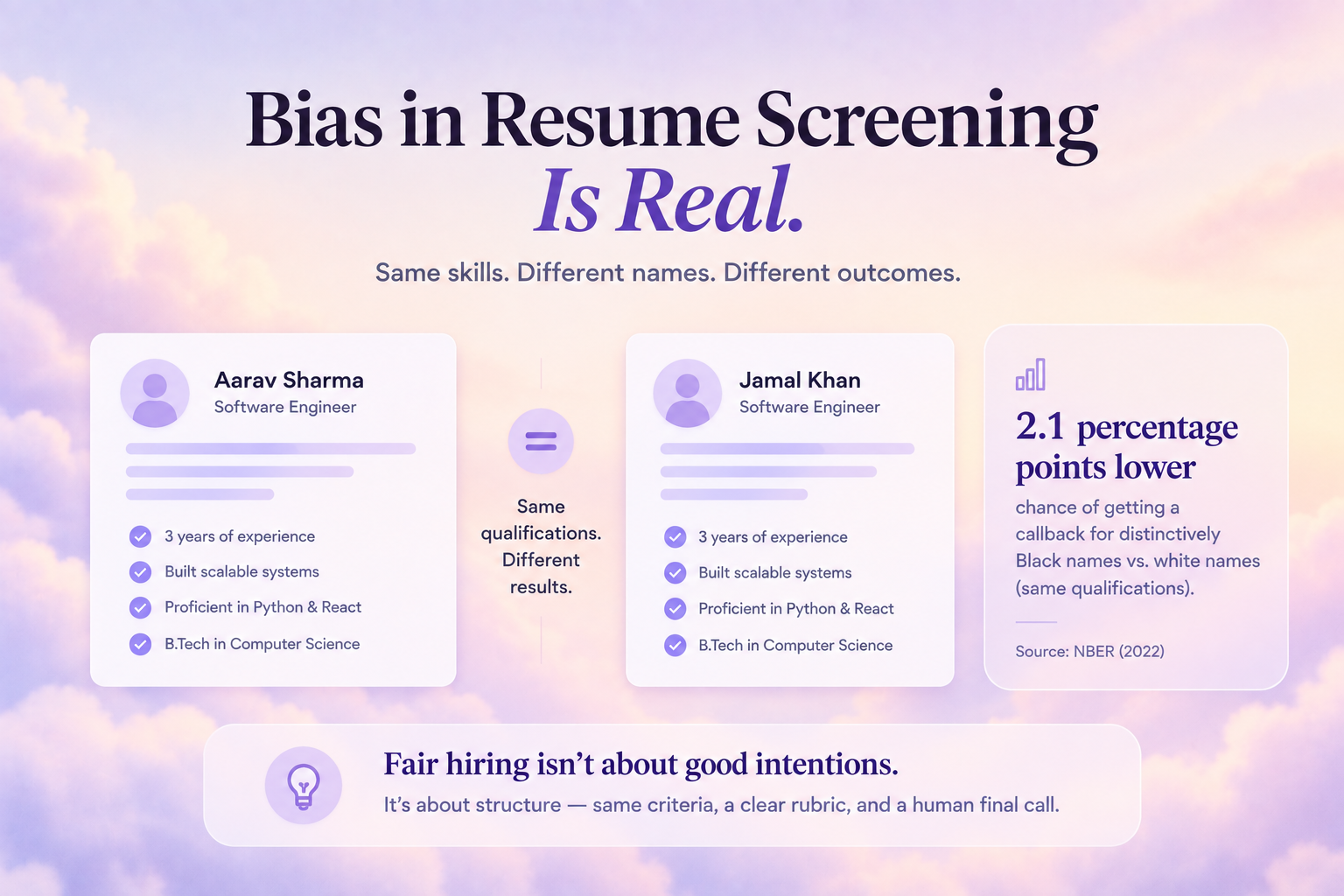
Is resume screening biased?
Yes. Field experiments keep finding that names and other résumé cues change callback rates even when the rest of the file is held constant. Bias in resume screening is a pattern in first-pass decisions, not a claim that every recruiter is acting in bad faith. Structure — the same criteria, in the same order — is how you interrupt that pattern.
The classic demonstration is older and still the mechanism people mean. Bertrand and Mullainathan’s Boston and Chicago résumé audit found white-sounding names received about 50% more callbacks than African American–sounding names on matched files (NBER Working Paper 9873). That’s historical fieldwork. The 2022 experiment shows the channel didn’t vanish.
Did You Know?
White-sounding names needed about 10 résumés per callback versus about 15 for African American–sounding names — roughly eight years of extra experience.
Myth
“If we mean well, or if we buy AI, bias in resume screening goes away.”
Reality
Good intentions don’t score files. CIPD is blunt: awareness is not enough; redesign the process. AI that ranks people is still a selection procedure. It can encode the same shortcuts unless humans set job-related criteria and review the shortlist.
Where U.S. rules apply, screening tools must not be designed or used to discriminate, and neutral procedures that disproportionately exclude a protected group still need to be job-related (EEOC). That’s about the method, not the software logo.
Fair Hiring Practices That Reduce Bias in Resume Screening
Does blind hiring actually work?
Blind hiring — stripping names and other identifiers before the first read — can reduce some first-pass bias, especially for women in some studies. Evidence that it always helps ethnic minority applicants at interview is mixed. Use it as one fair hiring practice, then still score the unblinded shortlist against the same rubric so “culture fit” does not undo the work.
CIPD advises removing names and contact details before managers review CVs, and notes that standardised questions make comparison easier than unlike PDFs. Full anonymisation is mixed for ethnicity at interview.
A UK trial CIPD cites, sending CVs to about 9,000 vacancies, found that replacing employment dates with years of experience reduced bias against women returning to work and raised callbacks by 15%. Gaps and graduation years are résumé cues too.
For more on why survey intake produces incomparable files, read Hiring Forms’ Google Forms vs. Hiring Forms: Why Spreadsheets Break Down When You’re Hiring.
| Cue on the file | Why it skews a fast screen | Fairer alternative |
|---|---|---|
| Name / photo | Triggers affinity and stereotype | Structured form; delay identifiers until scored |
| School names | Prestige proxy, not job proof | Skills and outcomes on a rubric |
| Exact dates | Punishes career breaks and age cues | Years in role, or examples of work |
| Postcode / “elite” employers | Socioeconomic shortcut | Job-related knockouts only |
| Keyword polish | Rewards résumé writers | Same scored categories for everyone |
How Do You Reduce Bias When Hiring?
How do you reduce bias when hiring?
You reduce bias when hiring by writing must-haves before volume hits, capturing comparable answers, scoring every applicant on the same criteria, and interviewing with a shared scorecard. Blind hiring and AI ranking are optional layers. The non-negotiable is consistent scoring so later files are judged like the first ones.
Definition
Consistent scoring criteria are a small set of job-related categories (for example role match, proof of impact, tools, knockout status) applied in the same way to every application, with knockouts reserved for true disqualifiers rather than preferences.
Do consistent scoring criteria reduce bias?
Yes, when the categories are job-related and used on every person. A shared rubric does not make humans neutral. It stops the exam from changing halfway through the pile. Blind hiring is optional. Consistent scoring is the bias reducer you can run on a lean team.
Evidence
CIPD cites evidence that using a rubric which sets out the scoring criteria and how to judge each response increased the likelihood that Black women would be selected for a role by 21%.
Source: CIPD — Inclusive recruitment: Guide for people professionals
- Write must-haves, nice-to-haves, and knockouts before you open a CV.
- Use a structured application so evidence is comparable.
- Score the same job-related categories for every person; keep knockouts pass/fail.
- Optional: hide names for the first pass (blind hiring).
- Shortlist by threshold, then interview with the same questions and a scorecard.
- Collect independent notes before the group debrief.
Score every file on the same few things:
- Role match against the brief
- Proof of similar work, not title clones
- Tools the job actually uses
- Knockouts kept off the “vibe” score
Iris Bohnet’s argument in Harvard Business Review still holds: unstructured conversation feels effective and predicts poorly. De-bias the procedure, not every mind.
Hiring Forms applies that at intake: custom categories, a score out of 100, knockout-rule checks, and a shortlist you can defend. AI screening is decision-support. You still set the rubric and make the hire. Start with one role at hiringforms.io — signup includes 25 free AI screening credits.
| Practice | Reduces… | Does not replace… |
|---|---|---|
| Consistent scoring criteria | Shifting standards and fatigue | A clear role brief |
| Structured applications | Unlike CVs and keyword theatre | Honesty checks later |
| Blind first pass | Name and school shortcuts | Interview and reference judgment |
| Job-related knockouts | Preference dressed as a filter | Human review of edge cases |
| AI rank against your categories | Uneven human scoring at volume | Accountability if the rubric is biased |
Expert Insight
“While many HR professionals would be shocked by evidence of discrimination, increasing awareness of the biases that affect recruitment is unfortunately not enough to reduce their impact. Instead, recruitment processes should be redesigned to reduce the influence of bias.” — CIPD, Inclusive recruitment: Guide for people professionals
Source: CIPD — Inclusive recruitment: Guide for people professionals
For a practical first-pass system that is built to compare people fairly, read Hiring Forms’ How to Screen Resumes Faster Without Losing Quality.
Lean-Team Hiring Context: Bias Shows Up as Speed, Not Slogans
A lean startup doesn’t run a diversity office. It runs a Drive folder. Bias in resume screening is operational: first-in, founder referrals, campus brand, no gaps. Fair hiring practices here are a one-page rubric used on every file.
India-based teams should watch local proxies, not imported ones:
- Campus brand used as a knockout
- Family name as a “culture” signal
- Notice period treated as character
- CTC “fit” used as a personality test
First-Hand Experience
In founder-led hiring, the biased screen looks like “I liked this one more” after a long PDF pile, with no shared categories. Teams that score role match the same way for every applicant — and keep knockouts binary — still make human offers. They stop changing the exam halfway through the pile.
Evidence
CIPD reports that only 28% of UK employers train all interviewers on legal obligations and objective interview practice, and fewer than a fifth test job-ad wording (18%) or check that tests are valid and objective (17%). Most first-pass bias is not a training gap. It’s an unwritten score.
Source: CIPD — Inclusive recruitment: Guide for people professionals
Rushing an unread pile makes those shortcuts worse. For more on that delay, read Hiring Forms’ Why Most Startups Take Too Long to Hire (And How to Fix It).
Can you reduce bias in resume screening without pretending humans are neutral?
Yes — if you change the first-pass system, not only the intention.
A fairer screen can:
- ✓ Apply consistent scoring criteria to every applicant
- ✓ Use structured applications instead of unlike PDFs
- ✓ Add blind hiring where it helps, without treating it as magic
- ✓ Keep AI as decision-support against a human rubric
It cannot replace:
- ✗ Job-related must-haves (not prestige proxies)
- ✗ Human judgment on the people you might hire
- ✗ Accountability if the rubric itself is biased