
TL;DR
How to screen resumes faster without losing quality: lock must-haves before you open a file, apply knockout rules, score against a shared rubric, then read only the shortlist in depth. AI scoring is one method among several — it speeds first-pass triage so humans interview instead of sorting every PDF.
Definition
Resume screening is the first-pass hiring step where a team decides who advances from an applicant pool by checking must-have qualifications, knockout criteria, and role-fit evidence. Done well, it’s a structured, comparable review that may use scorecards, knockout questions, and AI scoring as decision-support — not an automatic hire.
A 200-person pile doesn’t mean you have more talent. It means you have more files. Teams that know how to screen resumes well spend less time on the stack and more time with people who can do the job. Speed without a rubric is skimming. Quality without a system is rereading every CV while strong candidates accept another offer.
SHRM’s 2026 beginner’s guide on how to screen resumes efficiently recommends a 30-second must-have check, then a 2–3 minute in-depth read of role progression and quantified results for people who survive — so speed and a quality gate sit in the same pass.
How Do You Screen Resumes Efficiently?
How do you screen resumes efficiently?
You screen resumes efficiently by defining must-haves before volume hits, running a short knockout pass, scoring survivors against a shared rubric, and only then doing a deeper read. The goal of a fast resume review is consistent comparison — not equal minutes on every PDF. Humans still make the advance decision.
SHRM’s 2026 beginner’s guide treats screening as a checklist: confirm the job requirements, set scorecard metrics, confirm must-haves, then advance people or send a timely no. That sequence is what keeps resume screening tips from collapsing into “open the next attachment.”
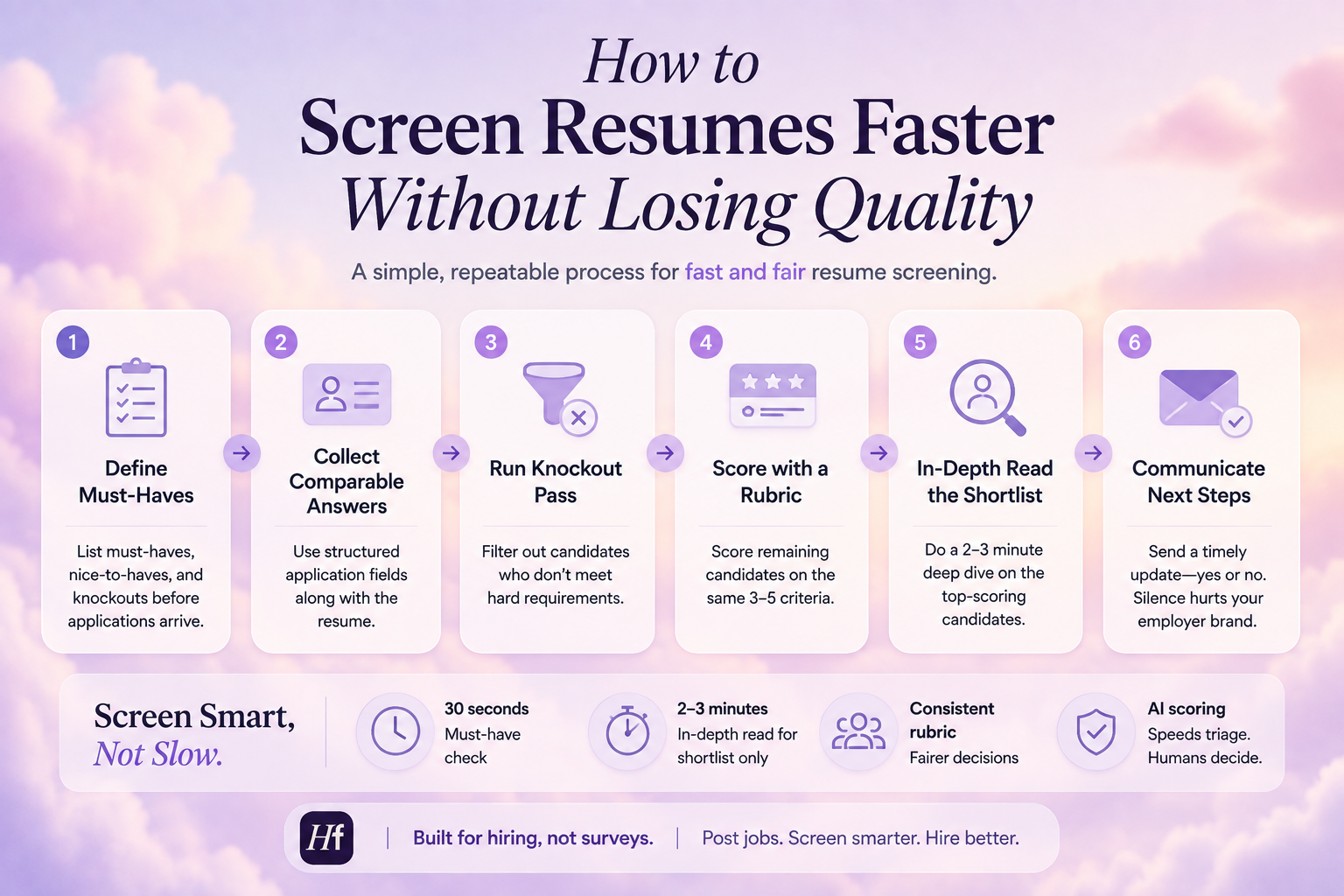
- Write the role’s must-haves, nice-to-haves, and knockouts before applications arrive.
- Capture comparable answers on the application — not only an uploaded CV.
- Run a first pass for hard disqualifiers (work authorisation, licence, location, notice period when it’s a true constraint).
- Score remaining applicants on the same 3–5 categories.
- Shortlist by threshold, then do the 2–3 minute in-depth read SHRM describes.
- Send a next step or a courteous no so silence doesn’t look like a process.
A useful first pass is short on purpose:
- Required credential or licence, if the job legally needs one
- Location / work-authorisation constraint you cannot waive
- Minimum evidence of the core skill (not a synonym hunt)
- Availability or compensation mismatch you already defined as a deal-breaker
Myth
“Quality screening means giving every résumé the same ten minutes.”
Reality
Equal time without a rubric spreads fatigue and shifting standards. Quality comes from the same criteria applied quickly, then a deeper read of people who pass.
| Approach | Speed | Quality risk if you skip the rubric |
|---|---|---|
| Open every PDF in arrival order | Slow | Recency bias; tired scoring by file 40 |
| Keyword skim only | Fast | Misses transferable proof; rewards résumé polish |
| Knockout questions + scorecard | Fast on the pile | Weak if “nice-to-have” is treated as a knockout |
| AI score with no human shortlist | Fastest | Score becomes the hire instead of decision-support |
Resume Screening Tips That Protect Quality at Speed
What should you look for in a first-pass resume review?
Look first for must-haves you defined in writing: the credential, the core skill evidence, and any true knockout. Then scan for proof of impact in similar work — not job-title clones. Save culture, “potential,” and edge-case career paths for the shortlist conversation, not the 30-second pass.
Definition
Knockout rules are binary, job-related disqualifiers (a required licence or an immovable work-authorisation constraint) applied before ranked review. They are not preferences, school prestige, or “we usually like five years” treated as a hard filter.
You don’t have to apply those knockouts by hand. Hiring Forms can check knockout rules automatically, so a CV that already fails a hard constraint never reaches the ranked pile.
Use that same split on your scorecard, not from memory:
- Role match — Core work, not only adjacent titles
- Proof of impact — Results, scope, or artefacts you can discuss
- Tools / domain — What the job uses, not a keyword dump
- Knockout status — Pass / fail, separate from the average score
Expert Insight
“Organizations can use a resume screening checklist to ensure their screening process is consistent and structured.” — SHRM Advisor, How to Screen Resumes Efficiently (February 2026)
Did You Know?
LinkedIn Talent Solutions notes that 62% of TA and HR leaders treated time-to-hire as their most important success metric, citing an average of 41 days from search to accepted offer in 2021 survey data.
For more on where screening delay sits in a longer funnel, read Hiring Forms’ Why Most Startups Take Too Long to Hire (And How to Fix It).
What’s the Fastest Way to Shortlist Candidates?
What’s the fastest way to shortlist candidates?
The fastest way to shortlist candidates is a layered pass: knockouts first, then a consistent score (human scorecard, AI scoring, or both), then a human read of everyone above the threshold. Screening large applicant pools fails when one person tries to rank 200 PDFs from memory in a single sitting.
AI scoring is one method among several. If you’d rather let AI do that ranked first pass, Hiring Forms scores each applicant out of 100 against categories you set, with a summary you can scan before you open the shortlist.
| Method | Use it when… | Do not use it as… |
|---|---|---|
| Knockout questions | The constraint is binary and job-related | A dump of preferences |
| 30-second must-have pass | Volume is high and criteria are clear | The only quality check |
| Shared scorecard | Two people must agree on “good” | Vague culture-fit scoring |
| Structured application answers | CVs are incomparable | A 40-field survey |
| AI score out of 100 | You need a ranked first pass | An automatic offer |
| Human shortlist review | Someone will take interview time | A rubber stamp of the rank order |
Evidence
LinkedIn’s candidate-dropout guidance cites a reported 20% increase in job seekers leaving hiring processes over a cited year — often when timelines stay vague. A faster, clearer screen protects quality and keeps people who still want the role.
Source: LinkedIn Talent Blog — 10 reasons candidates drop out
Where US employment-selection rules apply, screening tools are still selection procedures: they should be job-related, and the employer stays accountable. That’s the honest limit on AI in hiring — useful for ranking, not a substitute for a human decision.
Lean teams that want knockouts, a score, and the shortlist in one workflow can start with one role on Hiring Forms. Signup includes 25 free AI screening credits and no credit card.
Lean-Team Hiring Context: Screening Large Applicant Pools
Founder-led and small TA teams feel résumé volume differently than a bench of recruiters. One person is still shipping product. Applications arrive in a form, Drive folder, or inbox. By applicant 80, nobody can say who is actually strong. Screening large applicant pools without a TA department is a comparison problem, not a willpower problem.
Typical lean-team pattern:
- Week one: every CV gets a careful read
- Week two: “we’ll batch review on Friday”
- Week three: the best person from week one is already in another process
- Week four: the team concludes “the market is thin”
India-based startups should put real constraints on the form — notice period versus start date, work-authorisation, CTC when the band is public — rather than discovering them in interview five.
First-Hand Experience
In conversations with founder-led and lean recruiting teams, the break is rarely “we need more applicants.” It’s “we cannot tell who is strong without opening forty résumés.” Teams that write a rubric per role, apply knockouts, and score the rest — sometimes with AI screening as the ranked pass — stop treating screening as heroic PDF reading. The shortlist becomes a list you can defend.
Talent Board’s CandE 2025 benchmark coverage highlights that award-winning employers consistently make a go / no-go call within about three to five days after interviews. If the résumé pile already sat for two weeks, you spent the SLA before a hiring manager sees a name.
For more on why form-and-spreadsheet intake makes that pile worse, read Hiring Forms’ Google Forms vs. Hiring Forms: Why Spreadsheets Break Down When You’re Hiring.
Can you learn how to screen resumes faster without lowering the bar?
Yes — if speed comes from consistent criteria, not from skipping the shortlist read.
A strong screen can:
- ✓ Separate knockouts from ranked review
- ✓ Use a scorecard or AI scoring as a first pass
- ✓ Limit deep reads to people above a threshold
- ✓ Move a go / no-go before candidates drop out
It cannot replace:
- ✗ A clear role brief and job-related must-haves
- ✗ Human judgment on the people you might hire
- ✗ Hiring-manager time to actually interview