
TL;DR
An employee referral program can work: people hired this way often stay longer, and a simple program can help the rest of the team stick around. It falls apart when intros live in chat, skip the same checks, or only clone the current team. Process plus a real identity check makes referral hiring usable.
Definition
An employee referral program is how your team puts forward people they know for a live role: one place to send the intro, a note of who recommended whom, the same application as everyone else, and a bonus only if you pay one. That is referral hiring with a trail—not a private message that jumps the queue.
Most small teams already hire through people they know. A founder’s friend. An ex-colleague. A batchmate. You do not need to “start using referrals.” You need to decide if that intro is an employee referral program—or a favour nobody wrote down. The benefits of employee referrals are real. So is the usual mess: friends of friends, bonus hunting, and names you cannot find later.
Evidence
Researchers ran a randomised trial in a grocery chain (later published in the Journal of Political Economy). Referred staff left about 45% less often than similar people hired other ways. Stores with an employee referral program saw overall turnover drop about 15%. Much of that came from people who were not referred—they stayed longer when asked to help hire.
Source: Friebel, Heinz, Hoffman, and Zubanov — What Do Employee Referral Programs Do? (NBER w25920)
Do Employee Referrals Work?
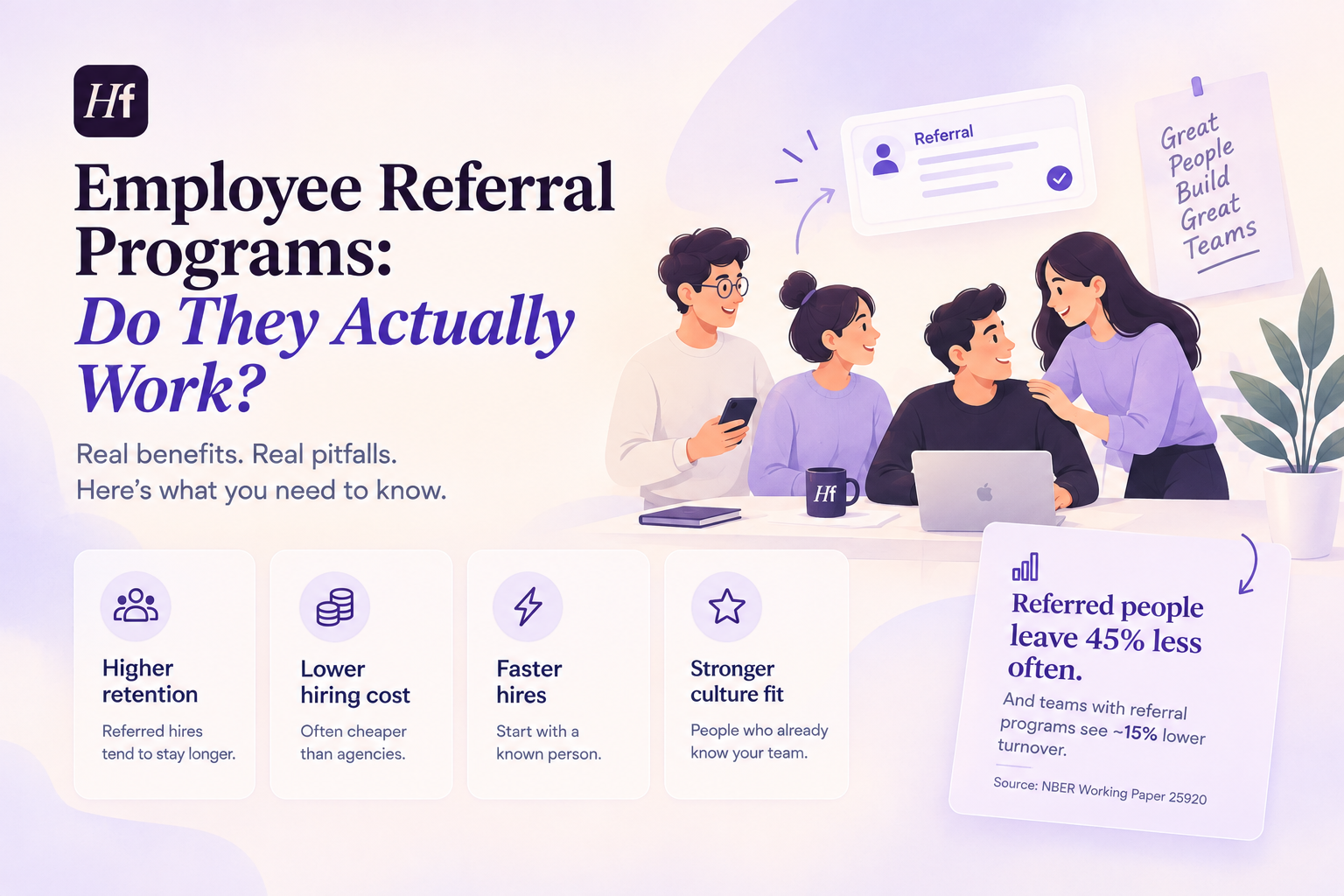
Do employee referrals work?
Yes, often—if you treat it as a real process. Referred people tend to stay longer, which saves cost. The same grocery study found bigger bonuses brought more names but weaker ones, and you may not get a flood of intros. Measure the channel. Do not use a friend’s name to skip the job description or a no.
CIPD’s 2024 hiring report says private-sector employers often find referral schemes useful when talent is scarce—if you keep hiring fair and keep your bar. Referral hiring can cost less than an agency. It can also fill the team with people who already look like you.
Myth
“If someone on the team vouches, we can skip the process.”
Reality
That is how a bonus and a friendship become the hiring system. Put referred people through the same must-haves. Keep knockouts about the job. A referral is a lead. It is not an offer.
| Benefit people cite | What the evidence supports | What it does not prove |
|---|---|---|
| Stay longer | The grocery trial: referred people quit less often | Every referred hire is a star |
| Cheaper than agencies | You skip some job-board and search fees | The bonus is free, or quality is automatic |
| Faster | You start with a known person, not a stack of PDFs | A chat forward is a fast screen |
| Culture fit | The referrer has seen the work | That “fit” is more than hiring friends |
| Staff feel involved | Other people stayed longer too | A Slack ping counts as a program |
Benefits of Employee Referrals—and the Real Costs
The benefits of employee referrals you can use day to day are simple. You get a warmer lead. The candidate has already heard what the job is like. Someone on the team owns the intro. The grocery study had a second finding: even stores that made no trial referrals saw less quitting. People liked being asked who should join.
A working employee referral program still needs:
- A live role with a written bar
- One capture path (form or link)
- The same screen as everyone else, plus a referrer on the file
The costs are equally operational:
- Homophily. People refer people like themselves. A 2024 Labour Economics field study asked 453 students to refer a classmate for a real job: 71% of women referred a woman and 75% of men referred a man (Hederos, Sandberg, Kvissberg, and Polano). That is a screening problem as well as a sourcing one—see Hiring Forms’ The Hidden Bias in Resume Screening (And How to Reduce It).
- Uneven scrutiny. A name from a founder can skip the knockout the public applicant hits.
- Bonus distortion. Bigger bounties can pull in more names and weaker ones.
- No record. If you cannot say who referred whom, you do not have a program.
Did You Know?
In the grocery RCT, even the largest bonus produced referrals as only about 5% of hires. A program can lift retention without flooding you with names.
Source: NBER Working Paper 25920
How to Run a Referral Program
How do you set up a referral program?
Write the rules before you ask for names: which roles, who can refer, when the bonus pays, and that referred people take the same application. Give employees a link, not a chat thread. Track the referrer on the candidate record. Then decide if you need LinkedIn verification so the intro is a person, not a rumour.
- Publish the live role with must-haves already written.
- Tell the team who can refer, the bonus, and that it pays after start.
- Give one referral link per role—not a WhatsApp forward.
- Attach referrer and relationship on the candidate profile.
- Run the same application, score, and interviews as public applicants.
- Verify the intro (LinkedIn verification is the piece most teams skip).
- Pay on a start; review who gets referred so the channel does not clone the team.
Why is verification the missing piece?
Most “programs” die in the inbox: a PDF, a first name, no profile. How to run a referral program on a lean team means the intro is structured and checkable. LinkedIn verification does not make someone qualified. It makes the referral a real person you can put in the CRM and score.
Definition
A verified referral is an intro you saved in your hiring tool: you know who sent it, and you have checked the person is who they say they are (for example with LinkedIn). You still score them against the job. A check is not a yes.
That is the product-shaped gap. Hiring Forms treats referrals as hiring-native: structured intros, LinkedIn verification, and the same candidate CRM as everyone else. AI screening is still decision-support. You set the rubric. Start with one role—signup includes 25 free AI screening credits.
| Chat forward | Structured, verified referral |
|---|---|
| ”Meet Rahul, he’s good” | Role, referrer, relationship, application |
| Lost in WhatsApp | Profile in the candidate CRM |
| Duplicate intros | One record, notes, stage |
| No identity check | LinkedIn verification on the intro |
| Bonus argued later | Rules written before the first name |
For more on why untracked intros stall a funnel, read Hiring Forms’ Why Most Startups Take Too Long to Hire (And How to Fix It).
Expert Insight
“These [professional/employee referral schemes] can be helpful and cost-effective in attracting candidates when the labour market is tight, and act as an incentive for employees to recommend their employer as a great place to work, but employers need to take steps to ensure that recruitment standards and equality, diversity and inclusion (EDI) issues are not compromised through such schemes.” — CIPD, Resourcing and talent planning report 2024
Source: CIPD — Resourcing and talent planning report 2024 (PDF)
Lean-Team Hiring Context: Referrals Are Already Happening
A lean startup does not need a “refer a friend” microsite. It already has batchmates and a founder who DMs. How to run a referral program at that size is a link, a rule, and a record. Pay only after someone starts, and score the referred person like anyone else.
India-based teams should watch local versions of the same risk:
- Campus / “our college” as the only network
- WhatsApp groups as the ATS
- Founder referrals that skip knockouts
Verify the intro. Do not confuse speed with a closed loop.
First-Hand Experience
Founder-led referral hiring usually fails as bookkeeping. The hire was “someone we knew,” the résumé never entered a pipeline, and later nobody can say who referred them. Teams that capture and verify the intro in the same CRM as public applicants still make human offers. They stop running HR in chat.
Evidence
CIPD’s 2024 survey of over 1,000 UK people professionals treats employee referral schemes as a recognised attraction method—especially in the private sector—and ties that to an EDI and standards warning. The program is the method plus the guardrails.
Untracked referrals also vanish in spreadsheet intake. For more on a hiring-native record, read Hiring Forms’ Google Forms vs. Hiring Forms: Why Spreadsheets Break Down When You’re Hiring.
Do employee referral programs actually work?
Yes—if they are a measured channel with the same hiring bar, not a chat shortcut.
A working program can:
- ✓ Raise retention and make staff feel involved in hiring
- ✓ Cut some agency and board cost
- ✓ Put intros in the same CRM as other applicants
- ✓ Add verification so the person is real
It cannot replace:
- ✗ A clear role and job-related knockouts
- ✗ Scoring referred people like everyone else
- ✗ Human judgement on the hire