
TL;DR
How to write a job description that attracts the right candidates: a searchable title, a short “as a [role] at [company]” summary, Key Responsibilities, Required vs Preferred qualifications, and What We Offer. Keep each list scannable. AI can draft that structure. You still decide must-haves, pay, and whether the work is real.
Definition
A job description is the written account of a role used to attract and screen applicants: title, summary of impact, key responsibilities, required and preferred qualifications, and what the employer offers; it is also the brief your team will score applications against, not a company brochure or a recycled task dump.
Most lean teams do not lose good people because the mission is unclear. They lose them because the posting is. A vague title, a novel of duties, and “competitive package” with no location or CTC is how the wrong pile arrives—or nobody does. JD best practices are boring on purpose: the same five sections, filled with the actual job.
Evidence
LinkedIn analysis of millions of U.S. paid job posts (April–September 2023) found high-converting listings were about 7% shorter overall. A cited survey found 90% of candidates said responsibilities help them decide whether to apply—and the responsibilities block in high-performing posts was about 9% shorter.
Source: LinkedIn Talent Blog — Data-Driven Tips to Boost Your Apply Rate
What Makes a Good Job Description?
What makes a good job description?
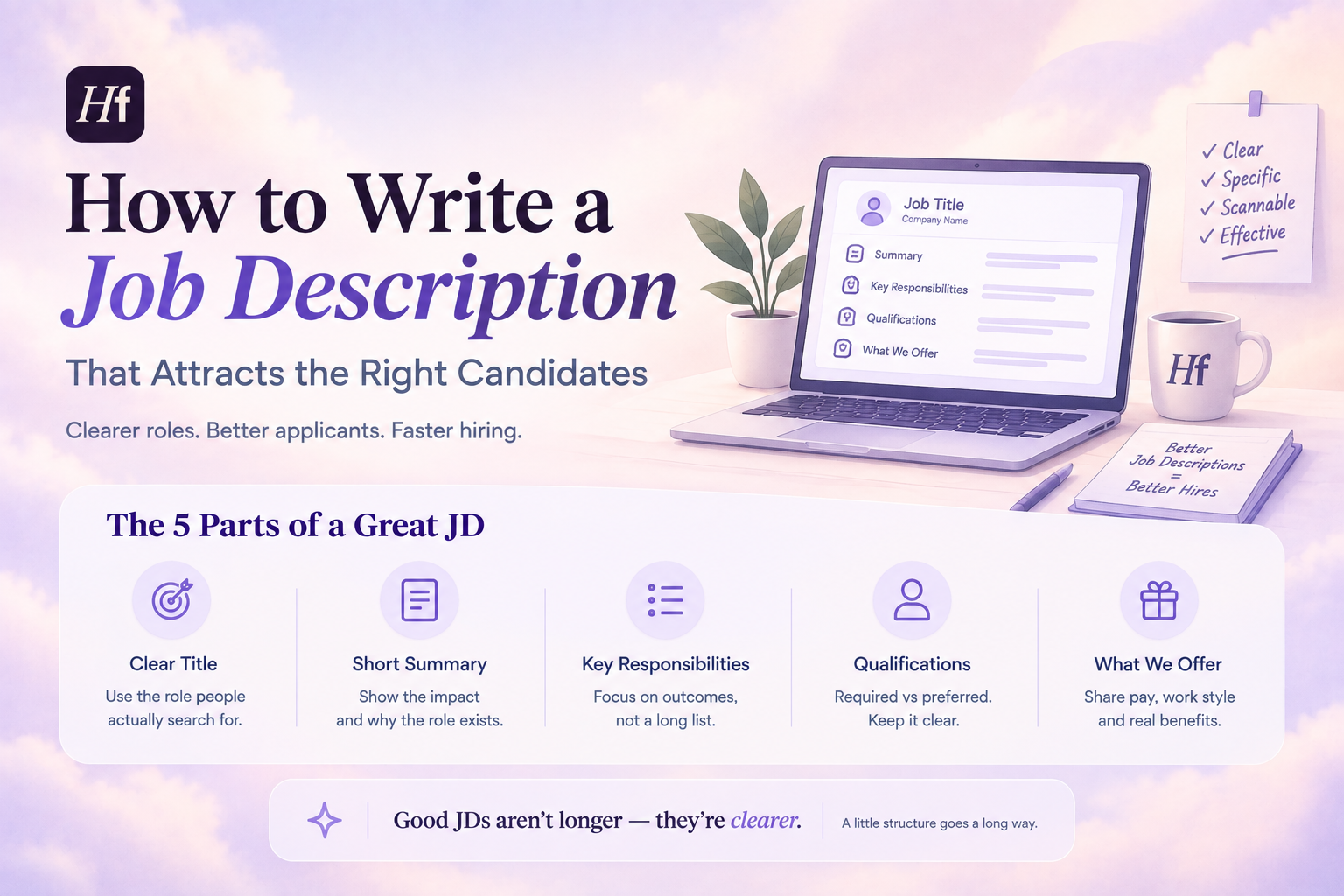
A good job description is scannable and specific. Candidates should see the title they would search, what they will actually do, which skills are required versus preferred, and what they get in return. LinkedIn’s hiring guidance treats those five parts as the core of how to write a job description—not a personality test in paragraph form.
LinkedIn Talent Solutions walks through the same skeleton lean teams already use in a structured listing:
- A clear, searchable job title (the role people type, not a nickname)
- A short summary of why the seat exists
- Key Responsibilities
- Required qualifications (and preferred, kept separate)
- Salary, benefits, and how you work—What We Offer
That is the shape of good JD examples. Fill it with evidence, not slogans. CIPD’s inclusive-recruitment guidance is blunt: list as few requirements as you truly need, and write them as behaviours people can prove—not as “natural leader” or “gifted communicator” (CIPD).
Myth
“A longer job description attracts better candidates because it filters harder.”
Reality
Extra bullets mostly filter for people with time and résumé polish. LinkedIn’s 2023 post analysis associated pedigree-heavy qualifications with weaker apply rates; hard-skills focus was associated with a 56% higher apply rate, and soft-skills focus with a 47% lift.
| Section | What it is for | Job posting tips |
|---|---|---|
| Summary | Why this seat exists | ”As a [role] at [company]…” plus impact, not a history essay |
| Key Responsibilities | The work | A short list of outcomes; tools the job uses |
| Required qualifications | The bar | Skills and proof; licences only if the work needs them |
| Preferred qualifications | Nice-to-haves | Keep this shorter than Required or it becomes the real bar |
| What We Offer | Why they would join | Pay or CTC band when you have it, work pattern, real benefits |
How Long Should a JD Be?
How long should a JD be?
Long enough to cover the five sections, short enough to scan on a phone. LinkedIn reports job posts with 150 words or fewer received nearly 18% more applications than posts of 450–600 words, and separately advises aiming for a concise listing with tight bullet lists. If a section is a wall of text, cut it—do not add a sixth heading.
There is no single magic number. LinkedIn’s own pages emphasize “less is more” in more than one study. Use that as JD best practices, not as a word-count contest: a complete structured JD can still be brief if each list stays focused.
Did You Know?
LinkedIn hiring guidance notes salary is the most important part of the job description for over 60% of candidates. “What We Offer” is not optional colour.
Harvard Business Review (Marlo Lyons, June 2024) puts the real work before you type: know the skill gap the seat should close. A short, accurate JD beats a long one written about last year’s job.
How to Write a Job Description: The Five-Part Draft
How do you write a job description step by step?
Decide the work, then fill the five sections in order: summary, Key Responsibilities, Required, Preferred, What We Offer. Split must-haves from nice-to-haves before you publish. An AI draft is a shortcut for the blank page. Publishing unread is how you attract the wrong pile.
- Write the problem the hire owns and three must-haves.
- Use a searchable title—the one candidates type.
- Open with a short “As a [role] at [company], you will…” summary.
- List Key Responsibilities as the work, not a department wiki.
- Put Required on skills and proof; move extras to Preferred.
- Complete What We Offer: pay or CTC, location, benefits you actually give.
- Publish a branded listing with a structured application.
A generator is useful when it outputs that same structure so you edit sections instead of inventing a template. If you want the draft and the application in one pass, Hiring Forms turns a plain-language brief into a job listing—built for hiring, not surveys. AI is a shortcut. You still own the bar.
For a speed-first version of the same workflow, read Hiring Forms’ How to Write a Job Description Fast Using AI.
Practical job posting tips inside that format:
- Name tools (Figma, SQL, HubSpot) in Required only if the job uses them weekly
- One licence or degree in Required only when the work legally or practically needs it
- Preferred stays optional—do not interview against it in secret
- Location, hybrid, and work-authorisation belong in the listing, not in email round three
Definition
Required qualifications are the job-related bar you will actually screen on; preferred qualifications are extras that can help a candidate stand out but should not silently become knockouts.
Expert Insight
“Whether you’re writing your job descriptions from scratch or using generative AI to help you get started, there’s always room for improvement.” — Greg Lewis and Manas Mohapatra, LinkedIn Talent Blog
Source: LinkedIn Talent Blog — Data-Driven Tips to Boost Your Apply Rate
Hiring Forms can draft the listing and the application together so the questions match the JD you just wrote. Start with one role—signup includes 25 free AI screening credits.
| Vague fill | Stronger fill of the same section |
|---|---|
| ”Shape user experiences" | "Design web/mobile flows in Figma; test with users; ship with engineering" |
| "Excellent communicator" | "You have presented research findings to PMs and engineers" |
| "3+ years experience” only | ”3+ years shipping UI for web or mobile, with a portfolio of that process" |
| "Competitive package” only | Pay or CTC band, remote/hybrid, and two benefits you actually offer |
| A department-wiki of duties | The work of a typical week, as a short list |
Lean-Team Hiring Context: The JD Is Your First Screen
A founder’s how to write a job description problem is usually time, not talent theory. The role lives in Slack. The posting is last year’s PDF. Candidates cannot tell remote from “Bengaluru preferred.” Small-team JD best practices are the five sections plus honesty about CTC, notice period, and work-authorisation when those are real constraints. A fuzzy JD also slows the funnel after you post—for more on that stall, read Hiring Forms’ Why Most Startups Take Too Long to Hire (And How to Fix It).
India-based teams should put real constraints in Required or What We Offer:
- CTC band, if you have one
- Notice-period expectations
- Work-authorisation / location
- Hybrid vs office, named
Do not discover those after a good interview. A structured listing also gives you knockout questions on the application so you are not rereading every CV for a fact the JD already asked.
First-Hand Experience
Lean teams rarely fail because the JD lacked poetry. They fail because Required and Preferred collapsed into one list, or because the posting never left a Google Doc. A five-part listing you can screen against beats a beautiful paragraph nobody used.
Evidence
CIPD reports that fewer than a fifth of UK employers (18%) test the wording of job adverts to reduce bias. Most first-pass “fit” problems start in the advert, not in the interview.
Source: CIPD — Inclusive recruitment: Guide for people professionals
A clear JD still fails if applications land in a spreadsheet. For more on publishing a listing instead of a survey link, read Hiring Forms’ Google Forms vs. Hiring Forms: Why Spreadsheets Break Down When You’re Hiring.
Can you learn how to write a job description that attracts the right candidates without a talent team?
Yes—if you use a clear five-part listing and tell the truth about the job.
A strong JD can:
- ✓ Open with why the seat exists
- ✓ Keep Key Responsibilities short and real
- ✓ Split Required from Preferred
- ✓ Put pay, work pattern, and benefits in What We Offer
It cannot replace:
- ✗ Knowing the skill gap before you post
- ✗ A structured application that matches the JD
- ✗ Human judgement on who you might hire